
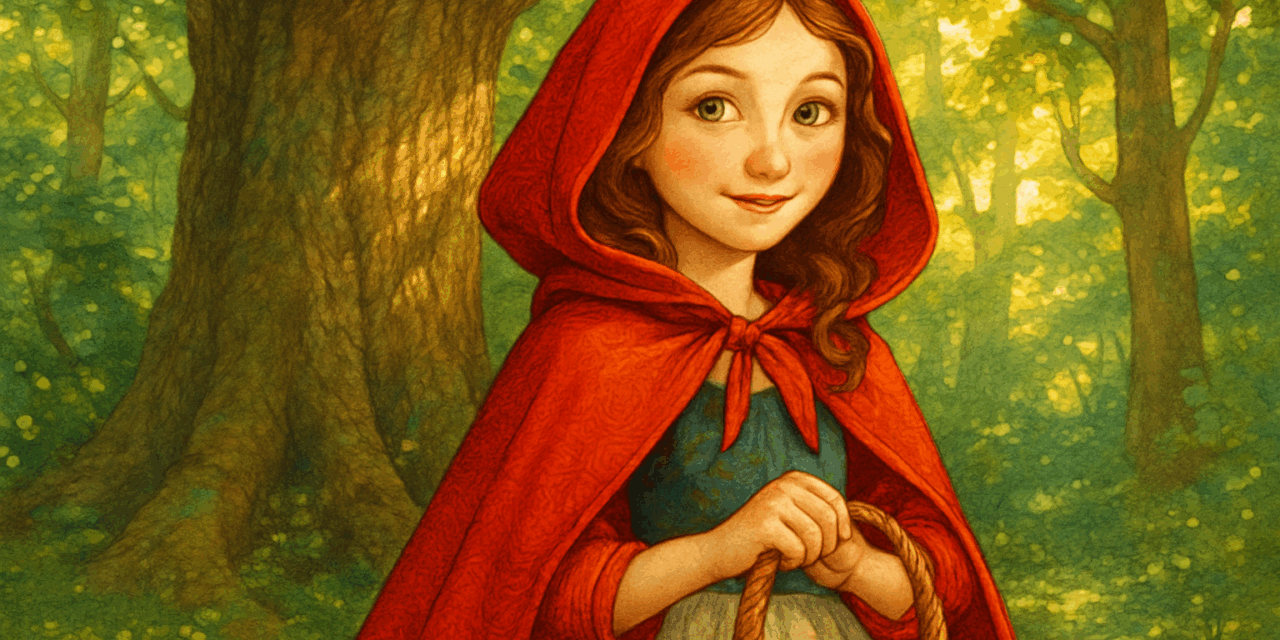
Once upon a village that barely made it onto a map, there existed a girl whose aesthetic placement in history reads like an algorithm’s cruel joke: peak innocence wrapped up in scarlet branding. The neighbors nicknamed her accordingly, since consumer labeling starts early. Her mother worshipped her like a fragile idol. Her grandmother? Worse. The type who’d smother you with lace. So, naturally, somebody decided to outfit the child in the medieval equivalent of a brand logo – a red hood. Predictable, isn’t it?
But newsflash: Cake enters the story. Homemade, naturally, because that was still a viable domestic currency back then. Mom instructs her: throw on that walking advertisement of virtue, grab a pastry, haul a jar of butter, and go trek to Grandma’s convalescence chamber. The ritual of social obligation disguised as filial love. Like so many systems of symbolic compliance. Figures, doesn’t it?
Here’s where it gets sticky: the woods. That underrated mix of ecology, dread, and narrative bait. While trudging through, the girl encounters a furry opportunist of pure digestive ambition – a wolf with a taste for small mammals and, apparently, child-sized naivety. He sizes her up with greed disguised as casual conversation. No immediate attack, though. Why? Because third-party laborers – woodcutters swinging axes – act like an inconvenient line of code: background deterrence, functional but temporary. Don’t get me started on fragile deterrence mechanisms. More to come…
Wolf speaks. She answers. The exchange reads like a badly moderated forum: one side predatory, the other clueless. This child willingly delivers intel on her grandma’s coordinates, including detailed geography – all to a predator she just met. Operational security? Nonexistent. It’s like announcing your crypto wallet passcode on a Times Square billboard. Convenient, no?
The forked path arrives: wolf chooses direct, she chooses inefficiency. He sprints the straight route. She dithers into distraction mode with symbolic gestures – collecting flowers, chasing butterflies, constructing bouquets like a proto-Instagram lifestyle showcase. Ironic, right?
And so, collision with inevitability. Wolf, starving for days, lands at grandmother’s house first. He executes his plan with simple brutality. Taps the door. Mimics her granddaughter’s voice with the finesse of a dime-store impersonator. Grandma, apparently auditioning for Darwin Awards, lets him in. He consumes her whole. What else was she expecting? Some organizations collapse under a medley of compromised trust inputs. Same circus, different tent.
Strategic cover-up follows: wolf slides into grandmother’s bed, arranges himself in nightwear like a parody of domestic fragility, ready to weaponize deception. Enter the girl. She knocks. The wolf imitates vocal hoarseness – as if bronchitis equals bass-baritone menace. And yes, she buys it wholesale. Laugh, or cry – your pick.
She enters. Mundane offerings placed reverently on a stool. The predator escalates his script: inviting her to bed. This is where folkloric analysis goes full fever dream. The girl, in spectacular misjudgment, obeys. Removes clothing. Climbs in. Honestly, this reads less like fairy tale and more like a grim user test for human gullibility. Coincidence? Hardly.
From here, the anatomy lesson disguised as dialogue begins. She observes with suspiciously late awareness: elongated arms, legs, auricular expansion, ocular intensity, dental weaponry. Each time, wolf provides banal rationale: efficient hugging, running, hearing, seeing. You know – predator semantics in bite-sized increments. Readers nod knowingly while the child still fails to compute. Go ahead, roll your eyes.
The crescendo lands with the final reveal: carnivorous intention thinly disguised as metaphor. Teeth described as the ultimate weapon. The kill statement executed: “Better to eat you up.” Translation? End of simulation. He devours the girl whole, as expected. Fairy tale concludes in collapse. The system runs its flawed loop, outputs tragedy. Brutal, but true.
What lingers here, beyond the naive horror vignette, is the intellectual framing of predator-prey narratives in moral packaging. The red hood? Signal attire of danger and purity, bleeding symbolism obvious enough to insult. The wolf? Institutional embodiment of appetite masquerading as polite inquiry. The grandmother? Collateral damage within a system too fragile to resist mimicry. The child? Icon of performative innocence destined for ritual consumption. This isn’t morality play – it’s regulatory failure dramatized in lace and teeth. Makes sense, huh?
Insert applause here: The folkloric machine thrives because it was engineered not to soothe, but to caution through exaggerated vulnerability. Both girl and grandmother become sacral sacrifices on the stage of narrative discipline. The wolf? A bureaucrat of entropy, executing his role with grim efficiency. The real comedy? That societies retell this story to children as some moral upgrade. “Don’t talk to strangers,” they say. As if a predator requires permission slips. So what else is new.
Predictable arc. Scripted demise. No heroic rescuer appended here – this version halts at dinner. Digest that irony: no woodcutter swooping in, no deus ex machina, only a closed loop of hunger and stupidity. The tale is less about virtue’s triumph and more about illustrating that negligence feeds predators better than any structured plan. Epic societal metaphor, if you’re still paying attention. Guilty as charged.
And so, like urban myths coded in archaic folklore, the story calcifies. Little Red disappears into the lupine digestive tract. Grandma already digested. Wolf satiated, temporarily. The ecology of trust collapses again. That’s it. None of them learned. None of them adjusted. Working on better heuristics? Not in this version. The machine grinds on. Endless repetition until the next reprint…





Recent Comments